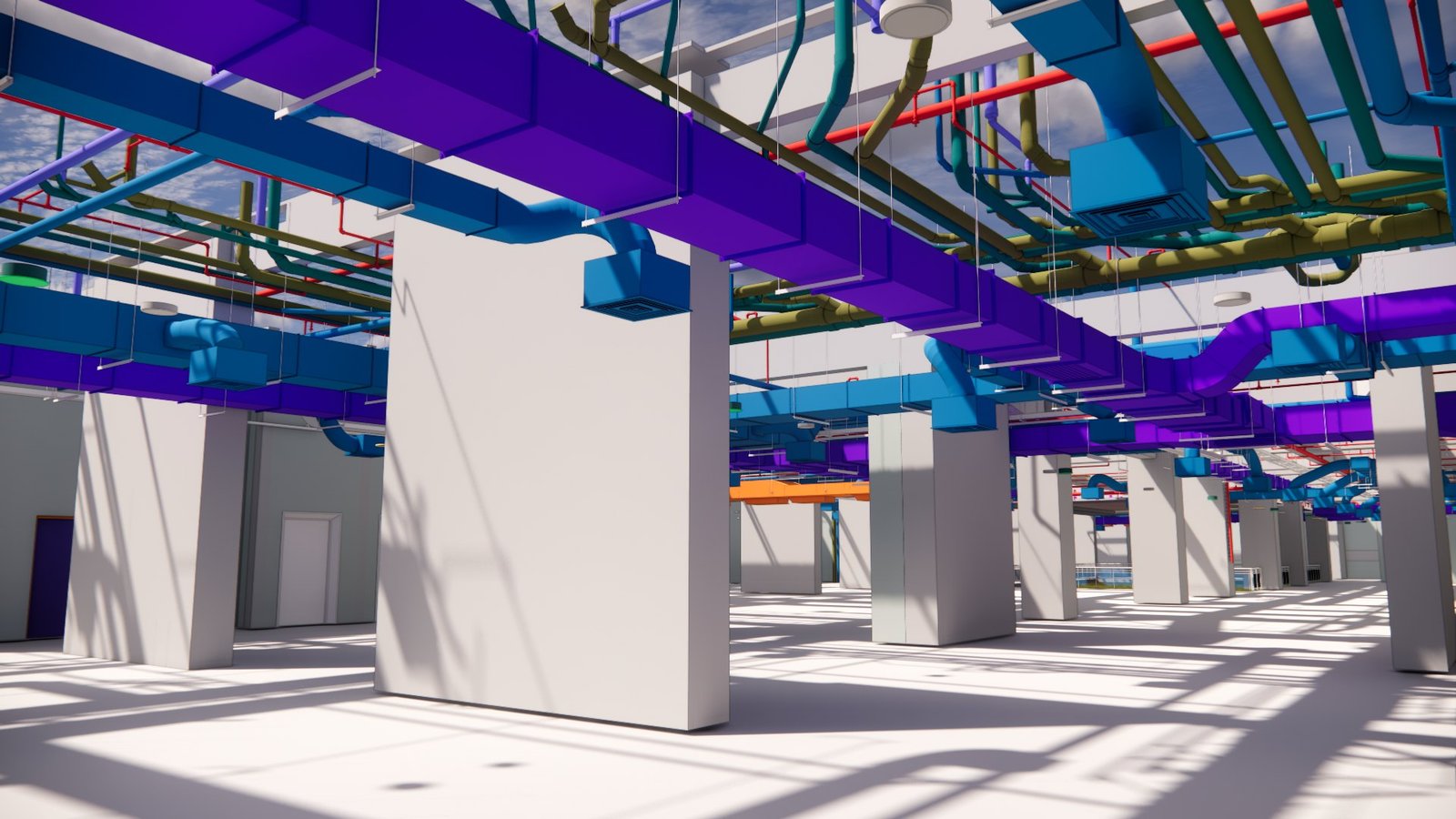
Most coordination finds clashes and fixes them. We plan every discipline's routing jointly first, so most of them never exist — fewer fittings, simpler runs, and a system your trades can actually install fast.
Before any clash check ever runs, we plan every discipline's routing together against the space itself — straight runs, minimized offsets, coordinated sequencing across systems. Clashes are designed out at the routing stage, not found and fixed after the fact. Zero hard clashes within agreed scope is a guaranteed outcome of that process — it's the floor, not the pitch.
Contractors on active data-center, mission-critical, or complex multi-discipline projects — especially where install labor, fabrication cost, or schedule pressure make a lean, buildable system worth more than a merely coordinated one.
Scoped to match your project's shape — a single zone, a full building, or a phased campus rollout — priced and timelined per scope, not a one-size fee.
We work from wherever your model currently stands — mid-design, post-DD, or already partially coordinated — and route it the rest of the way jointly, discipline by discipline.
A signed-off LOD 350 model, plus a delivered Optimization Summary benchmarking the routing against an unoptimized baseline — route efficiency, fitting count, install sequence, and construction time. Not a claim — an artifact, handed over before final payment.
A BuildPath model is the direct input to a Fab-Ready Package — and because the routing is already lean, the fabrication conversion starts from a leaner baseline.
Written into the engagement agreement before kickoff — no ambiguity about what the guarantee does and doesn't cover.
No blanket promises. Each guarantee states exactly what it covers and what it doesn't.
Zero unresolved hard clashes within agreed scope at handover. If a clash we signed off as resolved reappears due to our error, we remodel it at no charge — this covers our own rework cost, not downstream schedule impact or other trades' costs.
Covered if you gave us a solution and we implemented it incorrectly. Not covered if the RFI was left unanswered — we can't guarantee a fix we were never given the information to make.
We show the Optimization Summary before final payment is due. If it doesn't show a measurable reduction in fitting count, run length, or install sequence complexity, we say so plainly — before you pay the balance, not after.
The Sprint sizes to the project, not the other way around.
One system or building zone — a plant room, a wing, a floor of dense MEP routing. The right entry point when coordination risk is localized.
Complete MEP coordination across every level and system in the building. The standard scope for most standalone construction projects.
One phase of a multi-building or multi-phase program, coordinated on a schedule that lines up with the rest of the program.
Running a full multi-phase program, or want the same team to own the model through construction and closeout? Ask us — that's a separate conversation we scope individually.
Get a scored read on where coordination risk actually sits in your current model before committing to a full engagement.
See the ClashCheck Audit →Not every project needs full-building coordination up front. Ask us about scoping a single-system engagement against one trade or one system first.
Talk to us →No — it's a delivered artifact, not a claim. You get an Optimization Summary showing fitting-count and run-length reduction against a stated baseline, before final payment is due. If we can't show the reduction, we say so before you pay the balance.
If it's inside the agreed scope and it's our error, we remodel the fix at no charge — that covers our own rework cost. It doesn't cover downstream schedule impact or other trades' costs, which is why we run a live weekly review window to catch disagreements before sign-off.
LOD 350, across mechanical, electrical, plumbing and fire protection — the coordinated, route-optimized model the guarantees are written against.
First engagements run 20% at kickoff / 30% at mid-milestone / 50% at final, due on your written sign-off — weighted toward delivery, not trust. Repeat engagements move to standard terms.
Read/edit access to the federated model, your worksharing standard if one exists, and a kickoff call to confirm scope, LOD target and timeline. Before any model access is requested, we send a mutual NDA and a one-page data-handling summary — you shouldn't have to ask for it.
